Bases
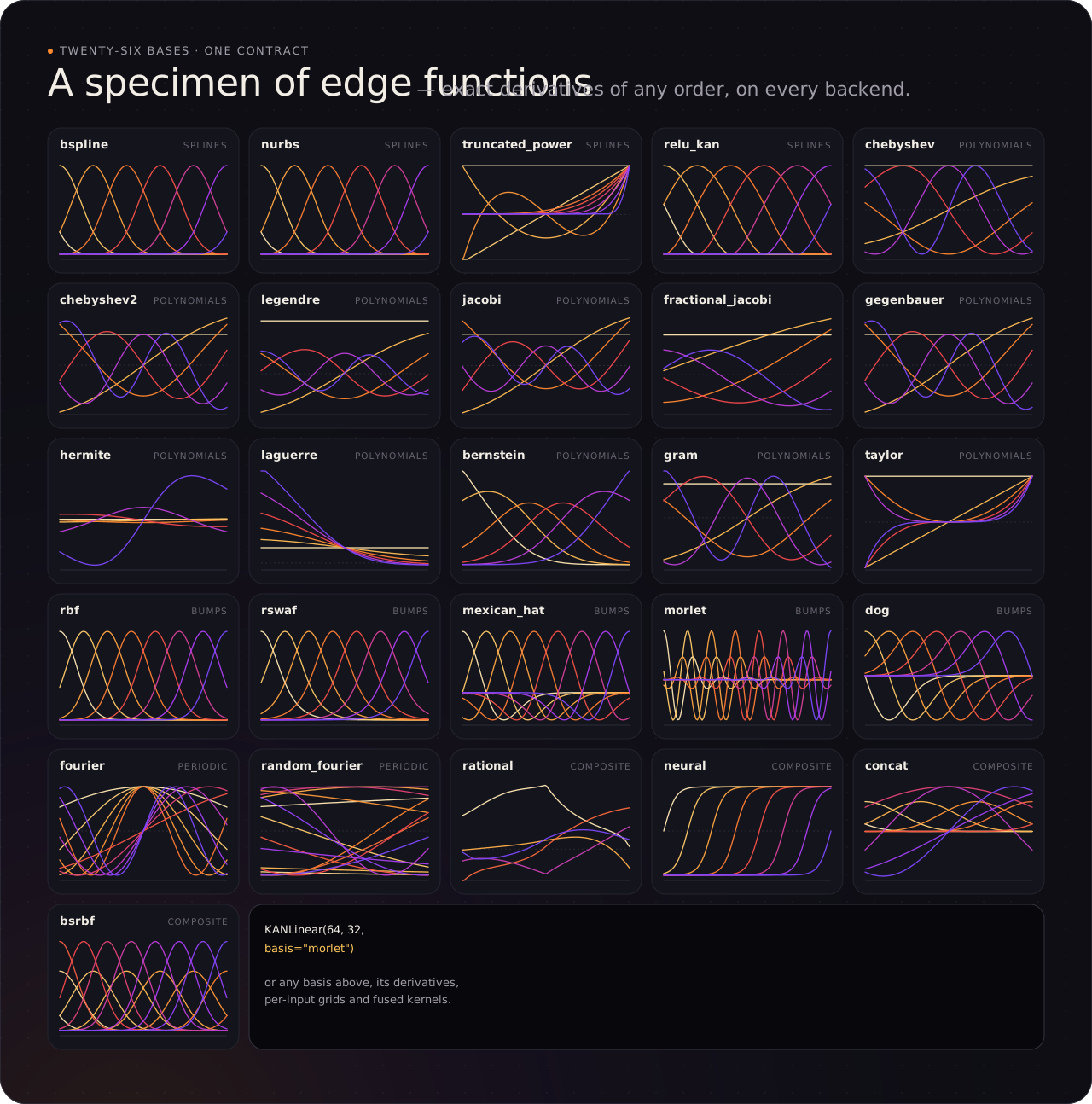
Every edge function is φ(x) = Σ_b c_b B_b(x; θ). A basis evaluates the B_b
for arrays of NumPy, PyTorch, MLX or JAX alike, shape (..., in) →
(..., in, size), and their derivatives of any order:
import numpy as np
import kanforge as kf

b = kf.BSpline(grid_size=5, order=3)
values = b(np.linspace(-1, 1, 7)[:, None])        # (7, 1, 8)
second = b.derivative(np.linspace(-1, 1, 7)[:, None], order=2)
kf.make_basis("chebyshev", degree=6)              # by name; also kf.make_basis(b.config())
| family | names (make_basis) |
notes |
|---|---|---|
| splines | bspline, nurbs, truncated_power, relu_kan |
per-input grids; NURBS weights and TruKAN knots trainable |
| polynomials | chebyshev, chebyshev2, legendre, jacobi, fractional_jacobi, gegenbauer, hermite, laguerre, bernstein, gram, taylor |
input map tanh (default), identity or fractional power (fKAN) |
| bumps, wavelets | rbf, rswaf, mexican_hat, morlet, dog |
centres on a grid or trainable (learnable=True) |
| periodic | fourier, random_fourier |
trainable frequency scale optional |
| other | rational (GR-KAN), neural (tiny MLP per edge), concat, bsrbf |
Parameters and grids. basis.param_specs() lists trainable parameters
(rational coefficients, wavelet centres, …) and fixed state such as grids
(trainable=False). Layers store them per input, per group of inputs or once
per layer.
Derivatives are analytic: polynomial families are stored as Chebyshev coefficients and differentiated with Faà di Bruno's formula through their input map; rational bases and NURBS use the quotient rule. They are checked against autograd up to the third order in the tests.